Locations




In a slower housing market, developers have the opportunity to revisit assumptions formed when demand was stronger and absorption was faster. Design decisions that once prioritized construction speed and density can now be subject to greater scrutiny.
One typology that deserves a fresh look is the back-to-back townhouse, where accommodating a third bedroom often results in a room without a window. While the unit may technically count as a three-bedroom home, the space does not function like a typical bedroom.
In some projects, back-to-back units are offered as two-bedroom homes instead. However, many buyers entering the townhouse market still expect three bedrooms.
In fact, national homebuyer surveys consistently show that three bedrooms is the most desired configuration, with about 46 per cent of buyers preferring this layout (source: NAHB, What Home Buyers Really Want, 2021).
This tension, between achieving density and delivering three comfortable bedrooms, is where the limitations of the back-to-back configuration become most visible.
Parking challenges in back-to-back townhouse design
Parking presents an additional challenge in back-to-back townhouse configurations.
When parking is located underground, construction costs rise. When parking is incorporated within the building itself, above grade, it triggers additional building code requirements mostly related to fire separation.
These requirements add complexity and cost to what is otherwise intended to be a relatively straightforward ground-oriented housing form.
A better alternative: Through-unit townhouses
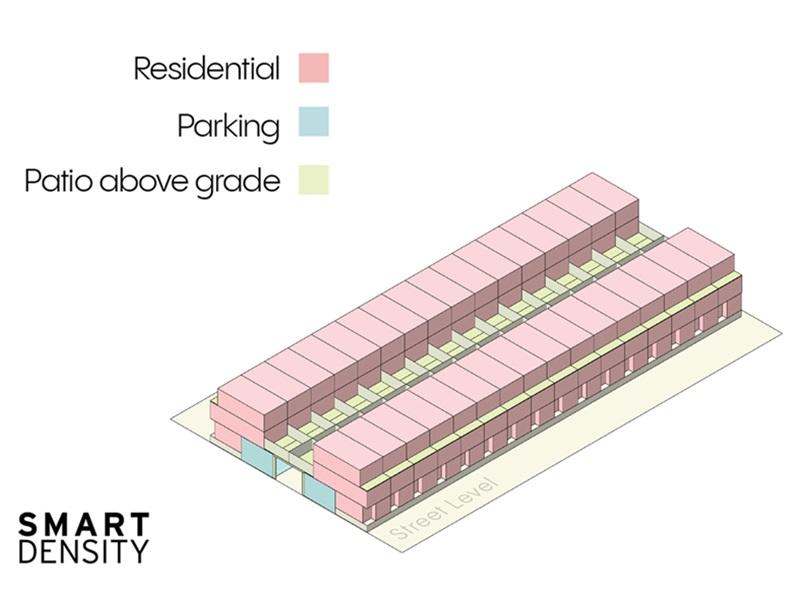
An alternative approach is to convert them from back-to-back to through units while still maintaining the compactness of the block. By organizing the units in two parallel rows with a narrow gap (~8 m) between them. That allows each unit to receive light from two sides rather than only one without losing the original advantages of the back-to-back configuration.
Access to parking could be solved by having a covered laneway in that same gap - it is typically not treated as a building under the Building Code requirements, and also acts as a private open space for the residents, accessed from the second floor.
This arrangement also tends to improve the clarity of the site plan. Instead of large internal circulation areas, access and servicing can be handled through the central covered laneway, allowing the fronts of homes to face car-free streets.
These adjustments do not necessarily reduce yield. In fact, with careful planning, they can maintain, or even increase, the number of units while improving the quality of each one. The result is a housing form that continues to deliver density while offering homes that are brighter and more aligned with what buyers are looking for.
Adjusting townhouse design in a cooling market
The goal is not to dismiss back-to-back townhouses outright. They emerged for understandable reasons and have played a role in expanding housing supply. But as the market evolves, it is worth asking whether we can achieve the same density while delivering homes that work better for the people who live in them.
A slower market creates space for these conversations. It allows the industry to refine the typologies we rely on and to align efficiency with quality.
When that happens, both developers and residents benefit.





 Industry Events
 Locations