
 Locations






While Canada remains a major global hub for higher education despite student visa caps negatively impacting international enrolment, it doesn’t have enough purpose-built student accommodation (PBSA) to meet demand.
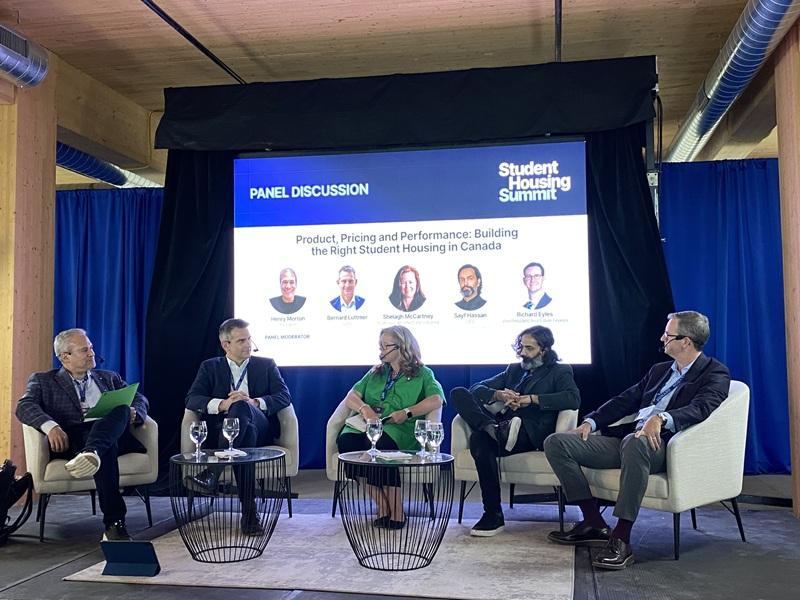
The recent Student Housing Summit organized by BONARD, a global market research and consulting firm that specializes in rented residential asset classes, at Toronto’s T3 Bayside brought together domestic and international players in the field to discuss this gap and the factors impacting PBSA in Canada.
The Canadian PBSA market remains heavily reliant on university-run residences and the number of beds they’ve delivered has dropped since 2023 while private stock hasn’t come close to picking up the slack despite steady rent growth and high occupancy rates.
Research cited at the conference illustrated how dire the housing situation is for many students in Canada. Between seven and nine per cent of them consider themselves unhoused and don’t know where they’re going to sleep the next night.
Affordability is critical
“Affordability is critical, in my opinion, because not only is it important for the current students that need the housing, but it also grows our market immensely,” said Bernard Luttmer, chief executive officer of Cedar Podium.
The Toronto-based company has delivered PBSA globally for more than 20 years, including properties in the Ontario cities of Toronto, Kingston, Barrie, Oshawa and Guelph.
“There's more than a million students in Canada living at home and going to universities, and they're making that decision primarily for financial reasons,” Luttmer continued. “So, if you can drive more affordable units, you can add hundreds of thousands of students to the student housing market that we provide.”
Luttmer explained that building affordable PBSA is difficult and often requires partnerships with schools and governments as well as sacrificing amenities that students might want.
“One of the advantages of working in collaboration with schools on campus is that you can design a little bit more towards what they need and not what they want because you have the machine of the university for marketing and leasing,” he elaborated. “You don't have to compete with an arms race of amenities.”
“Capital is always directed towards the most efficient, time-sensitive, risk-mitigated solution,” said Sayf Hassan, CEO of Elysium Investments and its new Yarra PBSA platform that has plans for projects in Toronto and Guelph and would would like to develop 10,000 PBSA beds within five to seven years.
Hassan stressed the importance of being able to “operate efficient, predictable, transparent and repeatable housing.” He’s also more interested in providing programming for students than a lot of physical amenities.
Public-private partnerships
There are potential opportunities in public-private partnerships that aren’t being capitalized on, said Henry Morton, president of Campus Suites, which has almost three decades of experience in developing and managing PBSA across North America and has Canadian properties in Toronto, Winnipeg, Calgary, Montreal, Ottawa, Oshawa and Thorold, Ont.
Public-private partnerships are becoming more important because universities don’t have as much money due to decreased international student enrolments and provinces not letting them take on debt for non-academic buildings.
Luttmer would like to see the private sector and institutions become better aligned through either ownership or profit-sharing structures, so that one party can't win without the other and they can share in the upside.
“Re-looking at the model, getting it done better and bringing private capital to help build the infrastructure on campus is critical to the educational sector, but also to the private sector and private developments,” said Richard Eyles, vice-president of real estate finance for mortgage services company CMLS.
“I don't see it as competition at all. I see it as building bigger educational communities where more people are living on campus, more people are engaging together, and the private sector around the school will do better.”
Scale in property size
“Scale is a great thing in the right markets with the right product,” said Luttmer. “Scale drives affordability significantly because you can operate buildings way more efficiently and it will bring the institutional capital that we need to build out the sector across the country.
“Big investors don't want 100-bed communities. They’re not interested. So scale has great potential, but scale done with the wrong product and the wrong market also can be a big disaster.”
Achieving scale with large projects in secondary markets is difficult and not being done much, according to Eyles.
Student socialization is important
Shelagh McCartney provided a unique perspective from her years of research as a Toronto Metropolitan University professor, as well as an architect and urbanist. She stressed the importance of student socialization and said the housing experience is part of the education experience.
“The gold standard for us is a small private room in a traditional dorm with bathrooms down the hall,” said McCartney, adding that the placement of the bathroom is the key to socialization.
That configuration results in a grade point average (GPA) that’s 11.8 points higher than for a student living in a private apartment, which is also the most expensive form of student housing to both build and rent. The GPA difference is 13.1 points for international students, McCartney added.
“If that's truly what students are looking for, certainly off campus, I don't know how you would finance that properly,” countered Eyles.
Four-bedroom apartments with two bathrooms also scored well in McCartney’s research.
“We need to think of amenity spaces as the everyday spaces that people are going to be using on a daily basis, and how we can leverage those into being the socializing spaces as well, like the laundry room,” said McCartney.




 Industry Events
 Locations