



 Locations





Commercial real estate investment in the Greater Toronto Area (GTA) rose by nearly 35 per cent year-over-year in the first half of 2026, reaching nearly $10.2 billion in transaction volume, according to Altus Group’s newly released Q2 2026 Toronto Commercial Real Estate Market Update.
“With the Canadian commercial real estate landscape as a whole, which includes Toronto, we're entering a bifurcated recovery that's really driven by a defensive yet opportunistic approach,” Altus Group senior research analyst Jennifer Nhieu, the report’s co-author, told RENX.
“Well-capitalized investors are funnelling heavily into very specific asset classes and anything that can offer income stability or is undergoing supply constraints or has long-term growth potential.”
Institutional investors still largely remain on the sidelines as private money is driving the bulk of deals, according to Nhieu.
Largest transactions of the quarter
The biggest second-quarter transactions were:
- Eight GTA senior housing properties totalling approximately $979.7 million as part of Welltower's $4.6-billion acquisition of Amica Senior Lifestyles from the Ontario Teachers' Pension Plan. The Amica Credit Mills property at 2465 Eglinton Ave. W. that was part of the portfolio sold for $191.04 million;
- BGO’s acquisition of the 23-storey, 330,000-square-foot office tower at 95 Wellington St. W. from Cadillac Fairview for $198.13 million;
- Pure Industrial’s acquisition of the 777,040-square-foot industrial complex at 4670 and 4680 Garrard Rd. in Whitby from Panattoni for $190.5 million;
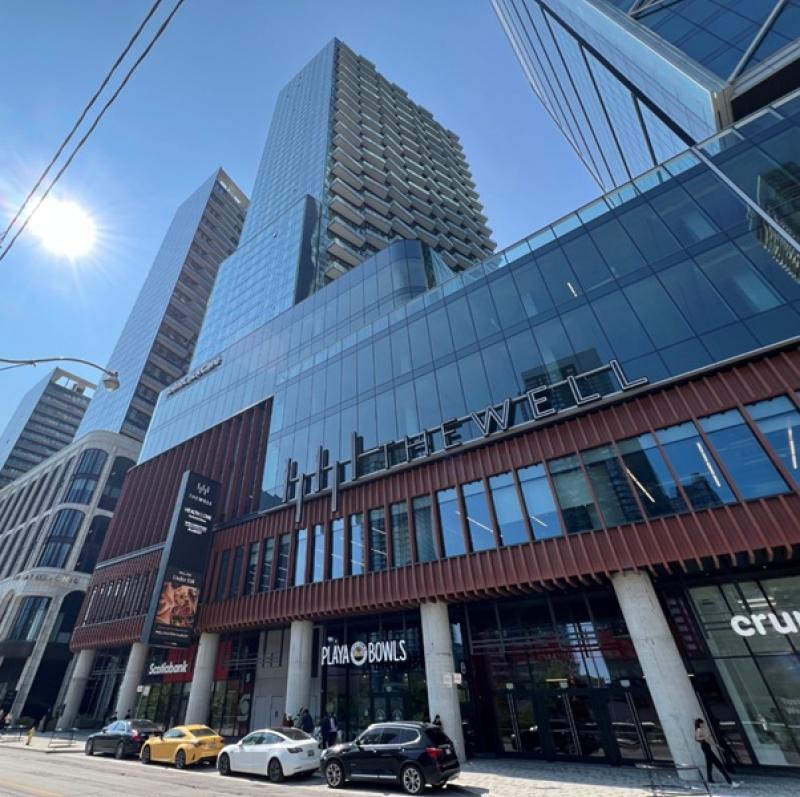
- and RioCan REIT’s sale of its 50 per cent share in the 46-storey, 592-unit FourFifty The Well apartment building at 450 Front St. W. to existing partner Woodbourne for $188 million, giving Woodbourne total ownership.
Multifamily saw $2.4B in transaction volume
The multifamily sector recorded nearly $2.4 billion in transaction volume, representing a 244 per cent year-over-year increase.
“The widening home ownership affordability gap, low-cost MLI Select financing and tax relief like the GST and HST rental exemption have made multifamily an attractive avenue for investment in 2026,” said Nhieu.
“Investors are looking past near-term supply deliveries to secure stable cash flow, backed up by a looming construction cliff that will likely choke future supply by 2027 and 2028.
“Not to mention, with post-2018 units exempt from rent control caps, capital is increasingly targeting purpose-built rentals for long-term growth and turnover rental upside.”
The highest performing GTA sub-market in terms of absolute transaction volume remained the City of Toronto at $1.17 billion, followed by Peel Region at $416 million. Durham Region and York Region had the strongest year-over-year growth, but both were coming off relatively depressed baselines at $6 million and $35 million respectively in the second quarter of 2025.
“Nevertheless, the strength of activity in both regions reflects genuine market momentum and underscores continued investor confidence in the GTA's suburban residential sector,” said Nhieu.
Office volume rose 125% YOY

Office investment activity continued to improve, with the total-transacted-dollar volume rising by 125 per cent year-over-year to nearly $1.2 billion.
There was a definite flight to quality, as there were 113 class-A transactions encompassing nearly 3.4 million square feet while class-B space accounted for only 15 deals that totalled approximately 271,500 square feet.
The latest Altus Group Canadian Office Market Update reported that Toronto’s office availability rate decreased by 200 basis points to 15.7 per cent year-over-year while the downtown class-A availability rate within the Financial District was 9.6 per cent.
“I would describe investor sentiment in the office sector to be very cautiously optimistic,” said Nhieu. “It's extremely trophy-focused and return-to-work mandates play a big role in that.”
Two fully leased office properties were delivered during the second quarter. The development pipeline contains eight buildings, totalling nearly 2.2 million square feet of space under construction, with only 23 per cent remaining available for lease.
“We are at a multi-year low when it comes to office construction,” said Nhieu. “I think gone are the days that we're going to see a single class-AAA office tower come out of ground-up development.
“I think most of the spaces that developers are willing to build are smaller and more flexible spaces that are built to suit.”
Industrial availability edges up
The industrial sector recorded nearly $3.6 billion in transaction volume, up 38 per cent year-over-year.
According to the latest Altus Group Canadian Industrial Market Update, Toronto’s industrial availability rate edged up by 10 basis points year-over-year to 4.8 per cent, reflecting a more cautious and measured leasing environment.
The GTA reported a constrained industrial pipeline in the second quarter, with seven completions adding nearly 1.1 million square feet to inventory. Despite this lower output relative to historical peaks, nearly 62 per cent of the newly added space remained available for lease at quarter-end.
With 39 projects totalling 11.3 million square feet under construction and 64 per cent of that space still available, availability rates were expected to remain elevated as these developments were delivered.
Nhieu said speculative construction has slowed significantly since 2023 but some developers continue to advance such projects because they want modern, future-proofed facilities to be ready to capture the next wave of demand. She also noted there’s still a need by smaller companies for smaller and mid-bay buildings.
Retail investment declined
Total GTA retail investment volume declined by 30 per cent year-over-year to just over $925 million. The drop reflected limited product availability, as owners retained stabilized assets, as well as elevated financing costs.
“You have a lot of investors actively seeking out food-anchored retail strips or retail frontages on very well-located retail corridors,” said Nhieu. “The demand is very much still there, it’s just extremely supply-constrained at the moment.”
There has been little in the way of major retail development in recent years, which Nhieu partially attributes to developers being concerned about the direct impacts of elevated input costs.
The regional retail market faced near-term headwinds from slower provincial population growth and softer consumer purchasing power. Elevated debt-servicing costs reduced household disposable income and weighed on consumer confidence.
Land
Industrial, commercial and institutional land transaction volume reached nearly $983 million, up 26 per cent year-over-year.
Residential land transaction volume dropped by 22 per cent to $1.1 billion.
“We don't see any underlying momentum that’s expected to bring it up,” said Nhieu.
Residential land activity remained constrained by prolonged municipal entitlement timelines, high development charges and compounding carrying costs in a stagnant interest rate environment.
Residential developers remained cautious, prioritizing site plan approvals and density optimization on existing land banks over acquisitions of unentitled sites.


 Industry Events
 Locations
