 Locations






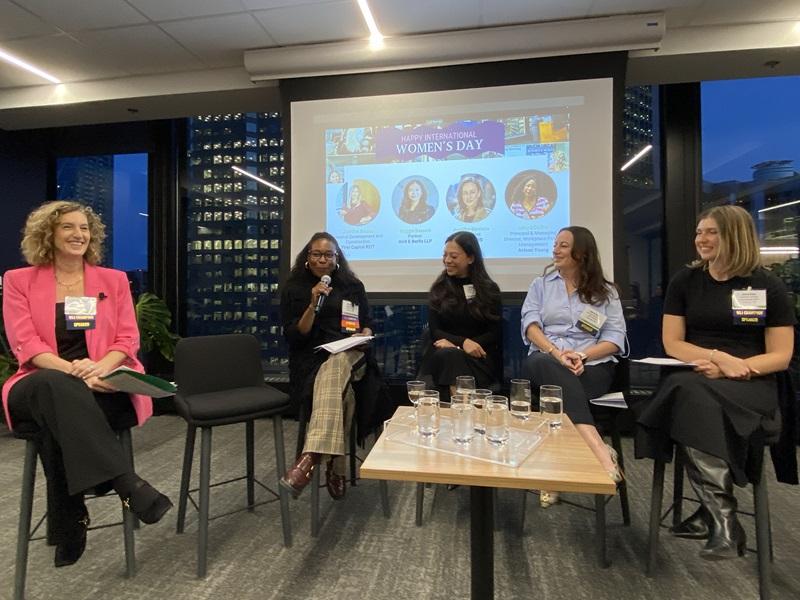
In advance of International Women’s Day (March 8), Urban Land Institute (ULI) Toronto’s Women’s Leadership Initiative presented a panel discussion at Avison Young’s downtown Toronto offices dealing with leadership in today’s real estate industry.
The panel explored real-world habits, lessons and leadership styles that are helping teams thrive through uncertainty, growth and change.
Mosaic People Development president Vanessa Judelman — a leadership trainer and coach, author and university lecturer who has partnered with CBRE, BDP Quadrangle, Cadillac Fairview, CAPREIT and RioCan — was the moderator. She started the evening, held March 4, by revealing the results of a survey she conducted noting the Top-5 things today's leaders are worried about:
1. Strategy feels impossible when everything is urgent.
2. Stress is the new normal.
3. Performance conversations are tough.
4. Influence without authority is real.
5. Isolation and self-doubt are growing.
Four women in leadership roles joined Judelman to share their views. They also engaged in a follow-up session with three younger industry entrants, answering questions and sharing experiences.
The keys to team-building
Each of the panellists shared perspectives on what it takes to build strong, high-performing leadership teams.
- “My job is to be of service to my people, my people's job is to be of service to our clients,” said Arlene Dedier, a principal, managing director and Canadian leader of project management services for Avison Young. “If we do those two things well, it becomes a reciprocating, self-aiding relationship.”
- “As a leader, you have to exemplify those traits that you want your people to follow,” said Jennifer Burstein, the co-founder and president of NOVI BLDS, a Toronto-based construction management firm. “Building trust, being accountable for your actions and being honest are some of the biggest things, because if you're dishonest or selfish you're breeding a culture of people who are dishonest and selfish.”
- “I've had hiring experiences where I'm down to final candidates and I don't look for who's smarter or who's going to do the job the best technically,” said Jennifer Arezes, head of development and construction for First Capital REIT. “I look for the outlook of the person, the attitude and what they bring to the office every day. Are they fun to be around? Are they enjoyable to work with? That adds so much to building a high-performing team.”
- “Technical excellence matters because that's why our clients hire us,” said Maggie Bassani, a partner in the municipal and land use planning group at Aird & Berlis LLP. “Clients don't hire us when there's a clear answer, otherwise they wouldn't need us. They come to us because it's unclear and there's uncertainty and change coming down the road. So when we're developing our associates, we're training them to exercise good judgment because, at the end of the day, this judgment protects our clients.”
- “Be yourself and be the best version of yourself,” Judelman added. “Be conscious of what you need to dial up, and down, to be most effective.”
Maintain perspective on "failure"
Bassani conceded she wasn’t as prepared as she should have been at times earlier in her career and didn’t put her best foot forward when dealing with errors or failures, which was humbling. However, she also realized there are very few mistakes that aren’t fixable and learned not to make those same mistakes again.
“I think the most important thing about failure is being accountable for the failure,” Burstein said. “If you're honest and bring it to the attention of people you need to bring it to, you'll find a way to work around it.”
Burstein continued later: “Don't be afraid to share it as soon as it happens, because you'll earn the trust and a good leader will not blame you for that failure.”
Building credibility and authority
Burstein stressed the importance of giving credit where it’s due, citing occasions earlier in her career when she was “subconsciously taking credit for other people's work” before realizing it and changing for the benefit of everyone.
“How powerful is it that I have the ability to take someone's work and give them the credit, while passing it up the chain and growing the emerging leaders from beneath me,” she said.
Bassani said it’s important to give credit to your team, but to also be accountable when things don’t go right. She also highlighted the importance of building trust up and down the ladder.
“Know your stuff, follow through, get back to people on time and build relationships,” Arezes said. “That builds your credibility within the organization.
“When you have that credibility, protect it with everything you have because it’s the most important thing you have when you want to be thought of for opportunities and growth within the organization.”
“Wherever you are in your career, if you’re of service to your team and your colleagues and your boss, you’ll get promoted,” Dedier said. “If you're always asking for something, then you're a task that has to be addressed.”
“The people that I think of for promotions are the ones that put their head down, they work hard, they’re accountable, they get back to me on time, they hit their deadlines and they communicate,” Arezes added. “It's not the people who are in my office every six months asking for a promotion.”
Improving diversity in real estate
“We're very much merit-based and we have a very strong culture of excellence but, all that being said, 60 per cent of people in leadership at First Capital are women,” Arezes said. “I think women bring a level of empathy and more diversity and more understanding than there was at the beginning of my career, and there's definitely more conversation about women in the industry and visibility and more attention being paid.”
That sentiment was echoed by Dedier.
“Our board has more women than men and our executive committees and leadership are diverse, which is intentional and comes from our global CEO,” Dedier observed, adding that Canada is more inclusive and often offers a better work-life balance than the United States, where she worked earlier in her career.


 Industry Events
 Locations