Locations





As sports venues evolve into anchors for mixed-use neighbourhoods, the real challenge is creating places that generate daily activity, long-term value and life beyond event days.
For decades, stadiums and arenas were planned as event assets. They drew crowds, concentrated spending and gave cities a visible landmark, then went quiet again once the game or concert ended. In weaker cases, they became expensive civic obligations with thin daily use and no real district around them.
Montreal’s Olympic Stadium still carries some of that history. Nearly 50 years after the Games, Montreal’s Olympic Stadium remains a useful case study in the limits of venue-led development. It has played an important civic and event role, but it has not consistently operated as the centre of a daily mixed-use district. Much of the public conversation around it has, therefore, tended to focus on repairs, public cost and its future.
That distinction helps explain the strategy behind the newer generation of stadium districts. Developers are no longer treating the venue as the whole proposition. The venue brings attention and periodic footfall. The district has to hold life between those peaks. That is where placemaking starts to matter in real estate terms.
Integrating stadiums into daily life
Public space, food, walkability, programming and tenant mix are doing more than shaping experience. They are being used to extend visits, support repeat demand and give the area a reason to stay active on ordinary days.
For developers, investors and asset owners, that changes the logic of the precinct. Seat count still matters. Attendance still matters. But a stadium cannot carry a district on its own.
Daily performance depends on what happens outside the gates: whether the public realm feels worth spending time in, whether the ground floor mix creates routine use, whether people have a reason to arrive early, linger or come back when nothing is on the calendar.
South of the border, the model is becoming clearer
The strongest stadium districts do not feel like event zones waiting for kickoff. They feel like neighbourhoods with a venue inside them.
The Battery Atlanta remains one of the clearest examples. Anchored by Truist Park, it has become a year-round destination rather than a project tied only to baseball traffic. Braves Holdings said the district welcomed nearly nine million visitors in 2025 and hosted more than 380 events and concerts across the campus.
Those numbers matter less as spectacle than as evidence of habit. Food, hospitality and events keep the district alive long after the baseball calendar runs out.
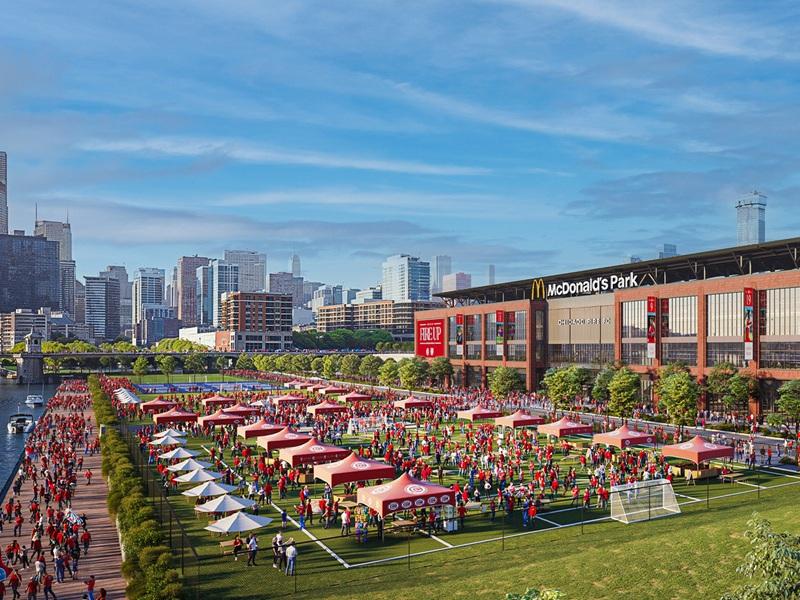
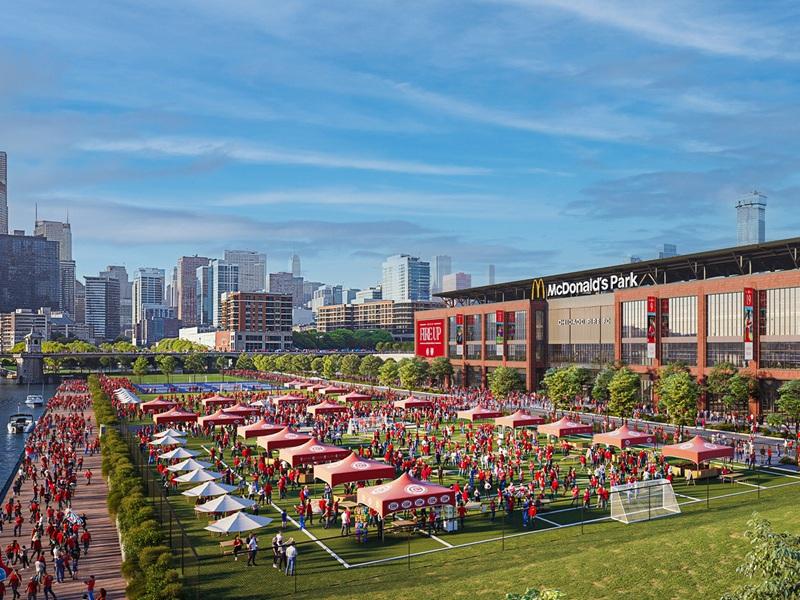
Chicago’s new Chicago Fire stadium gives a different version of the same idea. The project is being embedded within The 78, the 62-acre mixed-use district that Related Midwest is developing along the Chicago River. The 22,000-seat stadium is being privately funded by Joe Mansueto, owner of Chicago Fire FC.
That arrangement says a lot on its own. The venue is being used to anchor a larger piece of neighbourhood development. The physical ingredients are familiar enough: walkable edges, active frontages, food and beverage, and public spaces that stay useful outside event windows. Their role is not cosmetic. They extend visits, support recurring demand and make the district usable on days when nothing is happening inside the venue.
In projects like The Battery Atlanta and The 78, placemaking is doing commercial work.
Where Canada still looks uneven
Canada is in the conversation, but the results are uneven. Edmonton’s ICE District remains one of the clearest domestic examples of an arena-led mixed-use strategy. Vancouver’s Northeast False Creek points in a related direction through a more planning-led model, linking the BC Place area to housing, job space and public realm rather than treating it only as event infrastructure. Both cases suggest the market understands where things are heading.
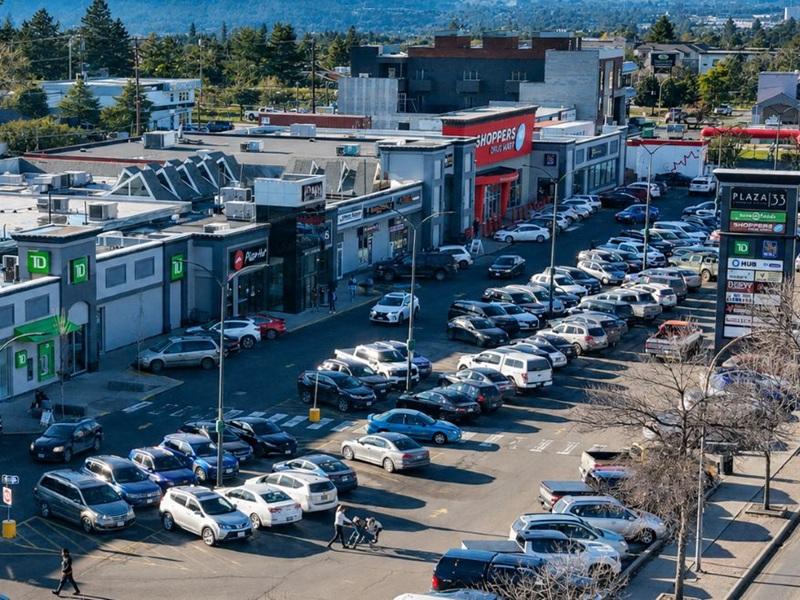
Toronto shows the gap more plainly. Exhibition Place already attracts millions of visitors each year and hosts a dense calendar of conventions, festivals and sports. On paper, it performs. On the ground, it still reads more as an event campus than as an integrated neighbourhood.
The weakness sits between the headline moments: limited daily life, limited routine spending and a public realm that still does not do enough work as an all-week district asset.
The 2026 FIFA World Cup puts that contrast under brighter light. Toronto is hosting six matches and Vancouver seven, which places both precincts under unusual international attention. The tournament can accelerate infrastructure, sharpen operations and raise the profile of both sites.
It cannot create the everyday conditions that make a mixed-use district hold together once the event cycle moves on.
What the model requires
Venue-led development behaves differently when it is built around all-day population instead of event surges. That starts with a real mix of uses. Symbolic retail at the base of a stadium does not do much on its own. District performance depends on public spaces that remain comfortable and legible on ordinary days, ground floors that give people reasons to arrive early and linger, and circulation that lets the area work as part of the city rather than as a fenced-off destination.
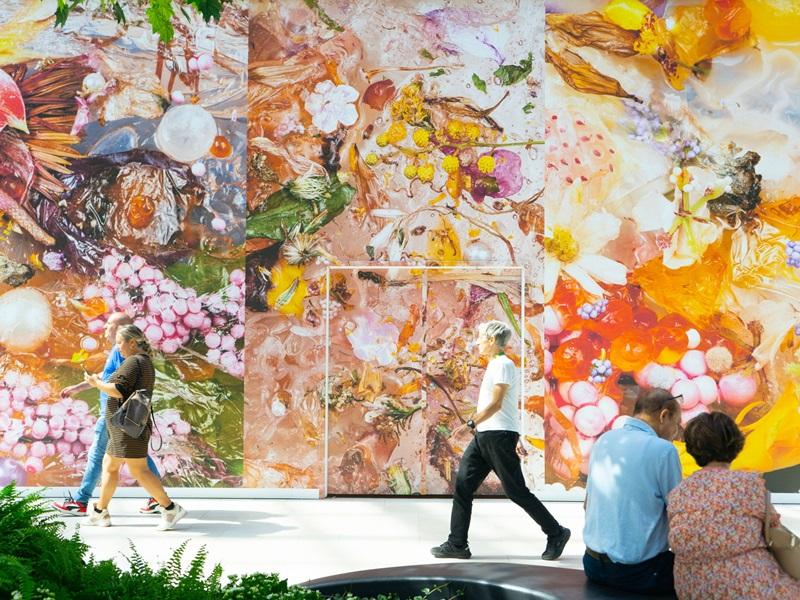
Placemaking sits inside that operating logic. A plaza, forecourt or pedestrian corridor does not create value simply by being there. It needs recurring use. Temporary installations, cultural programming, public art, food, shade, seating, lighting and small events can all help, but only when they build habits over time and give people a reason to come back.
Developers also need an operating strategy for the public realm. Someone has to program the space. Someone has to maintain it. Someone has to pay for activations outside major event days. Agreements between public and private partners shape how shared areas are used and managed.
Sponsorship rights, public access rules, event permitting, easements and maintenance obligations all influence whether open space functions as a district asset or drifts into leftover land between larger buildings.
Execution is the real test
Many stadium precincts sit at the intersection of public land, private development, municipal approvals, venue operations and community expectations. Governance has as much to do with performance as design does.
Placemaking is part of what makes a district work between event days. Programming is one piece of that, but it cannot carry the job on its own. Walkability, public space, food, circulation and everyday reasons to spend time on site all shape whether a stadium precinct functions as a neighbourhood or stalls as an event zone.
For investors and owners, that is a risk issue. A precinct that leans too heavily on event nights stays exposed to seasonality and underused land. A district that draws residents, workers, visitors and local consumers through the week stands on firmer ground. Leasing resilience improves. Long-term value looks more believable.
Canada still has relatively few examples where a major sports venue has been fully translated into a mixed-use neighbourhood with steady life beyond the event calendar. The idea is no longer the problem. Delivery is. The stadium may be the headline asset, but the district around it decides whether the project works for the rest of the year.





 Industry Events
 Locations