
 Locations



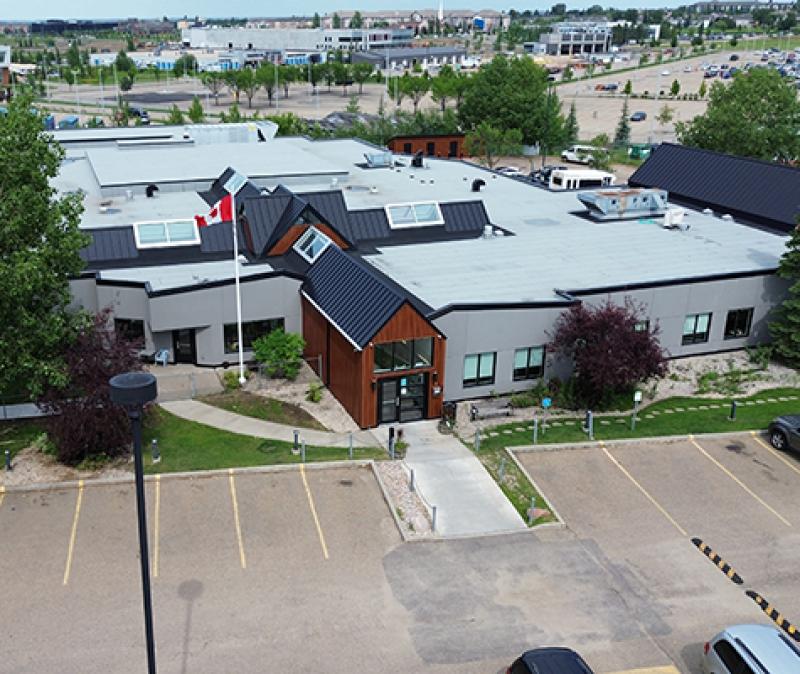
Roughly 80 per cent of Alberta's large commercial and institutional buildings were constructed before 1990. Many of the rest, including a circa-1997 stucco-clad, double-glazed facility in Edmonton, are now reaching the same point their older peers hit years ago: worn-out walls, windows and roofs that need to be replaced.
For owners, that timing creates a choice. Wait for the next leak, the next failed window seal, the next visible sign of trouble, and let the building dictate the schedule. Or get ahead of it with a single, coordinated project that treats the envelope as one interconnected system rather than a list of separate repairs.
“A coordinated retrofit allows the owner to manage the building’s condition proactively, rather than reacting to failures as they occur,” says Derek Zilke, principal and building envelope consultant at Wade Consulting Inc. “When an owner waits for a visible failure, the problem has often already progressed beyond the original deficiency. Leakage can lead to deterioration of the structural framing elements, and potentially mold or damage to interior finishes.”
That’s the calculation Wade Consulting made on a recent Edmonton project: the Robin Hood Association’s Broadway Learning Centre, a facility used by more than 100 people every day. The scope covered cladding, windows, doors, and roofing together. The assembly now includes EIFS with continuous insulation, an integrated rainscreen, and triple-pane fiberglass windows, and it had to happen without shutting the building down.
Zilke says tackling those components as one project, rather than one at a time, is where a coordinated approach earns its keep. “The interfaces between the roof, parapets, windows, doors and cladding are often where problems occur, because it’s where different trades start and stop their work,” he says. Sequencing that work together lets those interfaces be properly detailed at the same time, instead of one project undoing or modifying work completed under another. “As an example replacing a roof and later replacing the stucco with a thicker cladding system often requires the parapet and roof edge to be modified a second time,” Zilke notes. “A coordinated project reduces those sequencing conflicts and rework, and gives the owner a single, integrated solution with clearer warranty accountability.”
Phasing the work over several budget cycles can look appealing on paper, but Zilke cautions it isn’t free. “Phasing can increase the overall cost and extend the period of disruption,” he says. “If an underlying envelope deficiency is allowed to continue, deterioration of the backup wall or structural framing can progress, potentially turning a relatively straightforward repair or capital replacement project into a much more invasive and expensive project.”
The payoff isn’t only measured on a utility bill. Since the Broadway Learning Centre's envelope and roof replacement were completed, the building has experienced significant rain events without any reported water ingress, along with more consistent interior temperatures and improved occupant comfort. These durability and comfort gains sit alongside, not instead of, energy performance.
Wade Consulting wasn’t yet part of the AEEA Retrofit Vendor Network (RVN) when it was selected for the project, so the network had no bearing on how the work was awarded. What Zilke says he finds notable, in hindsight, is how closely the approach taken by the owner, Wade, and AEEA’s own philosophy aligned.
“The owner views the property as a long-term investment in their future and wanted to do the work properly the first time, rather than continually addressing individual failures as they arise,” Zilke says. “That gave us the opportunity to take a more holistic and forward-thinking approach to the building envelope looking at durability, energy performance, occupant comfort and long-term maintenance, rather than focusing solely on the immediate deficiencies.”
That philosophy, he says, is very consistent with what the AEEA and the RVN are trying to promote. “Becoming part of the network after the project was awarded was a natural fit, because we were already approaching projects this way,” Zilke says. “It reinforced that the way we were working with this owner was aligned with a broader industry approach to improving the performance and longevity of Alberta’s existing buildings.”
For an owner who has never used the RVN directory, Zilke says the value isn’t in replacing the consultants they already trust, it’s in what the network adds alongside them. “The value is in having access to a network of professionals who have a demonstrated focus and prioritization on energy efficiency and building performance, rather than simply selecting a consultant based on who you have used in the past,” he says. “That doesn’t mean an owner shouldn’t have relationships with consultants they trust. The RVN provides another way to identify professionals who understand how individual building components work together and who can help an owner think beyond the immediate repair.”
For an owner weighing a major capital project, particularly on a long-term property, Zilke calls the directory a useful starting point for building a more comprehensive, forward-thinking strategy. “It can help shift the conversation from ‘What do we need to fix?’ to ‘How do we want this building to perform in the future, and what is the right way to get there?’” he says.
For more information, visit www.aeea.ca.


 Industry Events
 Locations