Locations



For developers and asset managers, attracting people to a site is only part of the equation.
Not all busy places perform equally: some attract constant traffic but generate limited on-site activity. Others, even with lower volumes, support stronger leasing, higher spend and more consistent use throughout the day.
Across retail, mixed-use and transit-oriented developments, this gap is becoming more visible. Projects with similar traffic levels are delivering very different financial outcomes. Some high-traffic assets struggle to convert visits into tenant sales or sustained activity, while others outperform by capturing more time and engagement per visitor.
The difference is increasingly tied to one factor: dwell time.
The most resilient assets are not simply those that draw crowds, but those that convert that traffic into sustained, on-site activity. Longer visits tend to correlate with higher tenant sales, more cross-shopping, stronger repeat visits and more consistent activity throughout the day.
That raises a more pointed question for developers: once people arrive, what makes them stay and how can that be extended?
Increasing dwell time is rarely just a matter of adding more retail or amenities. More often, it comes down to something less mechanical and more strategic: the overall “lovability” of a destination. In practice, that means creating environments people do not just pass through, but actively choose to spend time in, remember and return to.
Foot traffic remains widely used, but on its own, it is becoming an incomplete and, in some cases, misleading measure of asset performance.
From movement to engagement
Foot traffic measures exposure. Dwell time reveals engagement.
This distinction is especially visible in high-flow environments. Transit-adjacent sites, for example, may benefit from strong baseline traffic but struggle to convert that flow into meaningful on-site activity.
Toronto’s Union Station illustrates the point. One of the country’s busiest transportation hubs, it has evolved beyond a commuter corridor through expanded retail, food offerings and improved public spaces. The objective is clear: create reasons for people to pause, not just pass through.
That shift has direct implications for performance. Research in transit-oriented commercial environments points in the same direction. A 2024 study of 89 U.S. airports found a 10 per cent increase in dwell time associated with a five per cent increase in non-aeronautical revenues, including eight per cent growth in food-and-beverage sales and six per cent growth in retail revenue.
In practical terms, longer stays increase the likelihood of cross-shopping between tenants, repeat visits and stronger overall engagement with a site – all of which contribute to tenant sales and leasing performance.
The same principle applies at a smaller scale.
A mixed-use project does not need landmark status to benefit from dwell time. A well-located café, visible seating, weather protection and a thoughtful ground-floor mix can extend visits, support adjacent tenants and strengthen leasing performance.
What successful places have in common
Projects that generate longer stays rarely depend on a single feature. More often, they offer a coherent set of conditions that build the overall “lovability” of a place, making it easy for people to pause, gather and return.
Bryant Park in New York is one of the clearest examples. Its success is driven by a combination of movable seating, continuous food offerings and programming that supports activity throughout the day.
London’s King’s Cross applies the same logic at district scale. Its strength lies less in any one destination than in the network: public spaces, food, cultural uses and year-round programming that encourage people to spend time across multiple touchpoints.
In Canada, STACKT Market in Toronto offers a more flexible model. Using modular infrastructure, it combined food, independent retail and programming to activate an underused site. Its early success came not from permanence, but from its ability to generate dwell time and shape perception quickly.
The lesson is not to replicate these projects at their scale, but to apply the underlying logic more deliberately. Dwell time is not created by a single feature, but by how consistently these conditions are embedded into a project.
For developers, that means thinking less in terms of individual amenities and more in terms of how the overall environment drives engagement, and ultimately, asset performance.
What actually drives dwell time
Across projects of different scales, the same drivers tend to appear consistently.
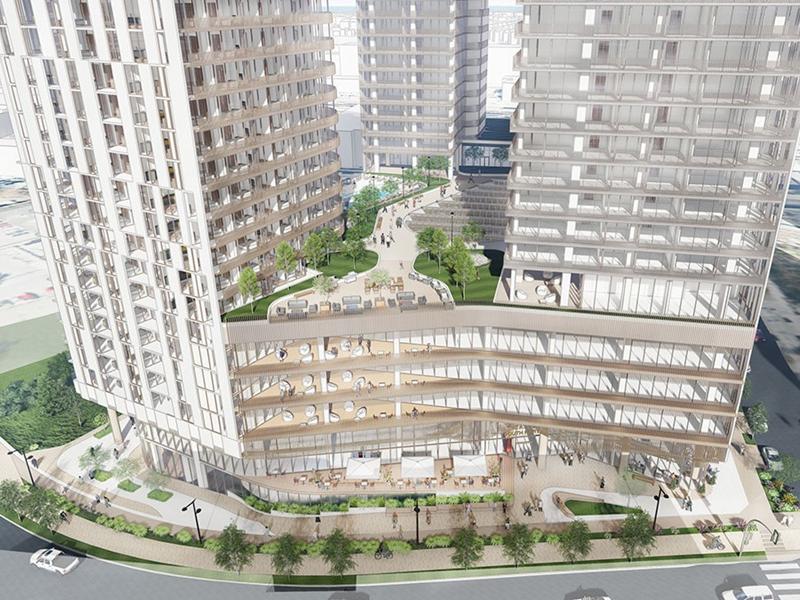
The public realm comes first. People stay where they feel comfortable. Seating, shade, weather protection and clear circulation all influence whether someone pauses or keeps moving and collectively shape the overall “lovability” of a place.
Food is another key driver. It creates routine, extends visits and anchors activity across the day. In many projects, it is still treated as a supporting use when it often functions as a primary generator of dwell time and cross-traffic.
Programming adds variation. Events, seasonal activations and informal uses give people reasons to stay longer or return more often. But programming works best when it reinforces the place rather than compensating for its weaknesses.
Identity also matters. Places that feel distinct and connected to their context tend to hold attention longer.
None of these ingredients is new. What matters is how deliberately they are combined.
Designing for time, not just space
For developers, the implication is straightforward. Dwell time is not just a byproduct of good design. It is a performance driver that can be shaped early through planning, tenant mix and public realm strategy.
The projects that hold attention longest are usually not the ones with the most features. They are the ones people find intuitive to use, comfortable to spend time in and worth returning to: in other words, more “lovable.”
That may sound like a soft idea, but in real estate terms, it has clear implications. More “lovable” destinations tend to extend visits, increase cross-shopping, support repeat activity and ultimately strengthen tenant sales and leasing performance over time.
This applies beyond retail. In purpose-built rental, shared spaces residents actively use can improve satisfaction, retention and overall positioning. At the district scale, the same logic supports more consistent, all-day activity and stronger long-term resilience.
None of this is accidental. “Lovability” is built through the cumulative effect of many decisions: active ground floors, usable seating, food and beverage, weather protection, identity and programming that give people a reason to linger.
Foot traffic still matters. But drawing people in is only the first step. The real opportunity lies in converting that traffic into time spent on site.
In the end, the places that perform best are often the ones people do not just visit, but choose to spend time in and return to. The ones that become part of their routine.




 Industry Events
 Locations