


 Locations







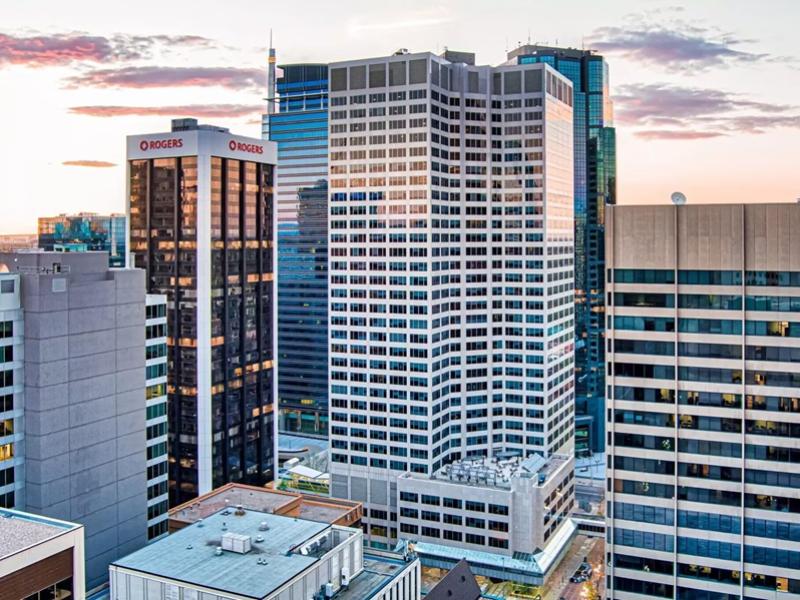
Calgary’s office market is increasingly divided, with downtown properties continuing to face challenges while suburban locations attract stronger leasing activity.
Population growth is helping drive demand outside the core, as businesses and service providers seek space closer to where people live, work and access essential services, attendees at last week's Calgary Real Estate Forum heard.
The shift is also changing the nature of office demand, with medical clinics, educational institutions and professional services firms taking up space traditionally associated with conventional offices.
The trend points to a broader evolution in Calgary’s commercial real estate market, where suburban growth is creating opportunities for landlords even as the downtown office sector works through persistent challenges.
Speaking at a panel on the office sector, Damien Mills, executive vice president, JLL, said the market in Calgary is moving into a really new season in office leasing with green shoots.
Changes in the office market
Since the significant downturn in 2016-2017, the downtown office market has settled into a vacancy rate in the high 20 per cent range while the suburban market has been in the mid teens per cent range.
Katie Sapieha, senior vice president, CBRE, said the divergence in the office market has taken place over the last year and a half, where a 10 per cent gap or difference has developed.
She said three factors have contributed to that change.
First, there have been many mergers and acquisitions which have impacted the downtown office market, leading to more sublease space available.
Secondly, “the suburbs have really benefited from Calgary’s population growth,” said Sapieha, adding that the office deals in that market have been non-traditional such as education, social services, government, daycare and non-profits.
Finally, she said the downturn in oil and gas, in recent years, freed up space from engineering and oil and gas companies in the suburbs with massive floor plates which had to be divided up, leading to smaller and more diversified leasing deals.
Sapieha said a healthy oil and gas sector in the downtown also has a domino effect with more office demand spinning out into the suburbs. “But the suburbs now kind of have their own demand driver which they’ve never really had and that’s because of population growth,” she added.
“But we also, in the last year, started to see the engineers come back. We have not seen (that) in a long time.”
According to the CBRE’s Q3 suburban office market report, the market reached its lowest vacancy level since 2014 at 15 per cent with positive net absorption in the quarter of 241,000 square feet.
Smaller footprints attractive in suburban market
CBRE said the suburban market maintained its strong momentum in Q3 with a vacancy decrease of 100 basis points. The year-to-date net absorption of 935,000 square feet puts the market on pace for one of the strongest years of growth ever recorded.
Growth was driven primarily by small- and mid-sized transactions in the quarter as options under 5,000 square feet remain the most in demand, the report said, with available options in this size range falling by 19.5 per cent year-over-year.
All submarkets experienced positive net absorption in Q3 except for the South Central submarket. The Northeast experienced the largest positive net absorption of all submarkets at 99,000 square feet.
The suburban office market around Calgary has an inventory of 25.7 million square feet.
Downtown sees increase in activity

CBRE’s Q3 downtown office market report said the overall vacancy rate fell slightly in the quarter to 28.4 per cent with positive net absorption of 324,000 square feet. It was the second strongest quarter of net absorption since Q3 2014 “as the market avoided any large negative shocks while seeing an increase in activity from a variety of industries, including energy and education.”
The report said sublease space fell by 19.2 per cent and is the lowest level since Q2 2024. Overall vacancy in the downtown fell by 80 basis points in the quarter. That has been aided by the removal of 22 buildings from the inventory due to conversions.
The downtown office market has an inventory of 41.2 million square feet.
The big driver of downtown leasing is the energy sector and will continue to be the energy sector and professional services, Oxford Properties director of office leasing Jace Jonsson told the forum.
Oxford experienced absorption of 400,000 square feet in the last quarter.
Corbin Staniloff, asset manager, leasing and development, with Armco Capital, said the family-owned company based out of Montreal and Halifax made a decision about three years ago to enter into the downtown Calgary office market.
The company now has five Calgary properties, including the Bow Valley Square complex, and it is in the process of closing on another property, Staniloff told RENX, speaking after the panel session.
“We believe in office," he said. "We think that there's going to be a return to office. We like the industry. We like Alberta. We have a lot of oil and gas relationships. We think that there's great energy, positive momentum.
"And then we're also opportunity-driven, so we look at opportunities countrywide. But the cap rates, the price per foot, the assets themselves — these are just at a very attractive price."
He added: “We'll always look for more. However, at the beginning of the year, we said that this was the year of consolidation, so we thought we weren't going to buy more. We need to focus on what we have, and we need to make sure that the assets that we do have perform very well.
"So, we are focused on optimizing what we have. If something comes around, frankly, George (Armoyan, president of Armco) will probably take a look at it. But I don't think the growth mode is necessarily our focus right now.”


 Industry Events
 Locations

