Locations



Montreal’s industrial market faces a flat year of transition in 2026 with better outcomes ahead in 2027, according to Jean-Marc Dubé, executive vice-president and group practice lead at Colliers Canada in Montreal.
“I am quite bullish about the industrial market,” he said, speaking at a session on Montreal’s industrial sector during the Montreal Real Estate Forum April 14-15 at the city’s convention centre. “If we’re not at the bottom of the market in my opinion, we’re scraping the bottom.”
After years of “meteoric growth and tons of lease deals,” he said the city’s industrial market heard crickets last year until Labour Day, when transaction volume improved significantly.
Dubé sees better outcomes for owners and property managers heading into 2027 because a significant lack of industrial construction in Montreal should lead to higher rents.
He noted Montreal sits at the bottom of North America’s Top-10 markets in terms of new construction, compared with inventory.
About one million square feet of new construction is expected to be delivered in the Greater Montreal Area this year, to add to its approximately 370 million square feet of inventory. That's the equivalent of about 0.6 per cent: “Extremely low for a market of our size.”
Rents down, vacancy up ... for now
Average rents have fallen from a peak of $16.80 to about $14 per square foot and “I think we’re going to live in this $14 net rent average for quite some time.”
The industrial availability rate is 6.5 per cent, with much of the availability in smaller buildings of 100,000 to 200,000 square feet. There are 43 listings in Greater Montreal for buildings of that size, compared to only five listings for buildings over 500,000 square feet.
There is little availability in the newer LEED, net-zero, high-clearance class-A buildings which tenants are seeking.
Dubé notes the 6.5 per cent availability rate includes two million square feet that Amazon brought back to the market in 2025, after announcing the closure of its industrial fulfillment and delivery facilities in Quebec. However, “Amazon’s buildings are still leased. They’re paying their rents. They have not approached our landlords to cancel their leases.”
He says landlords seeking to rent buildings of 100,000 to 200,000 square feet are being creative by dropping asking rates for the first year to attract tenants. Their hope is they’ll be able to obtain significant increases in year two and beyond.
Rosefellow tries to stay ahead of demand
Tenants are taking a lot longer to pull the trigger but “once they do, that timeline is very, very short,” said Mike Jager, co-president of developer Rosefellow. It can take tenants up to two years to pick a building but once they do, they want to move forward without a 12-to-24-month planning horizon. “They want that space now.”
Rosefellow’s mindset is to “build ahead of demand and to usually take the calculated risk to build on spec. In today’s market, waiting can be the bigger risk.”
Jager said Rosefellow has seen an uplift in industrial demand since December and is building several buildings, primarily on spec, including 300,000 square feet in Boisbriand on the North Shore, 500,000 square feet in two buildings starting in May in Laval, two buildings in the Montreal borough of Saint-Laurent of 175,000 square feet, and 200,000 square feet in Candiac on the South Shore.
For its part, developer Broccolini continues to build purpose-built industrial buildings, said Paul Broccolini, the company’s executive vice-president. “Generic buildings are going to be tough to fill,” he said.
Interest in new buildings is coming primarily from the food-related sector, Broccolini said. While the government has announced a huge surge in military spending, “I think we’re two years away from the trickle-down effect,” with industrial buildings for the military sector.
Building carbon-neutral industrial
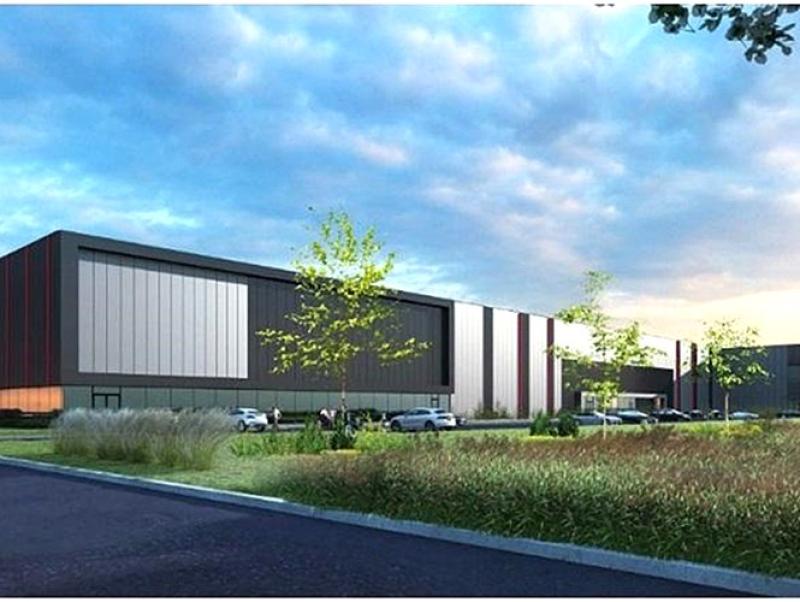
Ugo Cianciulli, director of real estate development at Loracan, described his 40NetZero project in Montréal-Est, now underway, as the largest carbon neutral industrial campus in North America.
The development will see 3 million square feet of industrial buildings built on 7 million square feet of land and private investments of more than $1 billion.
40NetZero has already delivered a 400,000-square-foot, $150-million distribution centre to pharmaceutical firm McKesson Canada. A 200,000-square-foot spec building will be available in June, and construction will begin at the end of summer on a 240,000-square-foot spec building.
Dubé said the acronym VUCA – which stands for Volatility, Uncertainty, Complexity and Ambiguity – best describes the current industrial market.
“I’ve heard a lot of industrial occupiers say ‘We want to wait and see what’s going to happen. We want it to be stable again for us to be able to make decisions,’” he said. “Well, that’s not going to happen. We are living in unstable times. It will continue to be this way.”
Jager added: “There’s always a temptation in uncertain times to wait for specific clarity. Unfortunately, real estate doesn’t reward perfect timing. By the time you have clarity, the window of opportunity has passed.”
Whether it’s tariffs, wars or Covid, there will always be problems, he said.
“But you’ve got to believe that things will change, that there will aways be a tenant for a building. You have to be an optimist and if you’re not, you shouldn’t be a developer.”


 Industry Events
 Locations