
 Locations



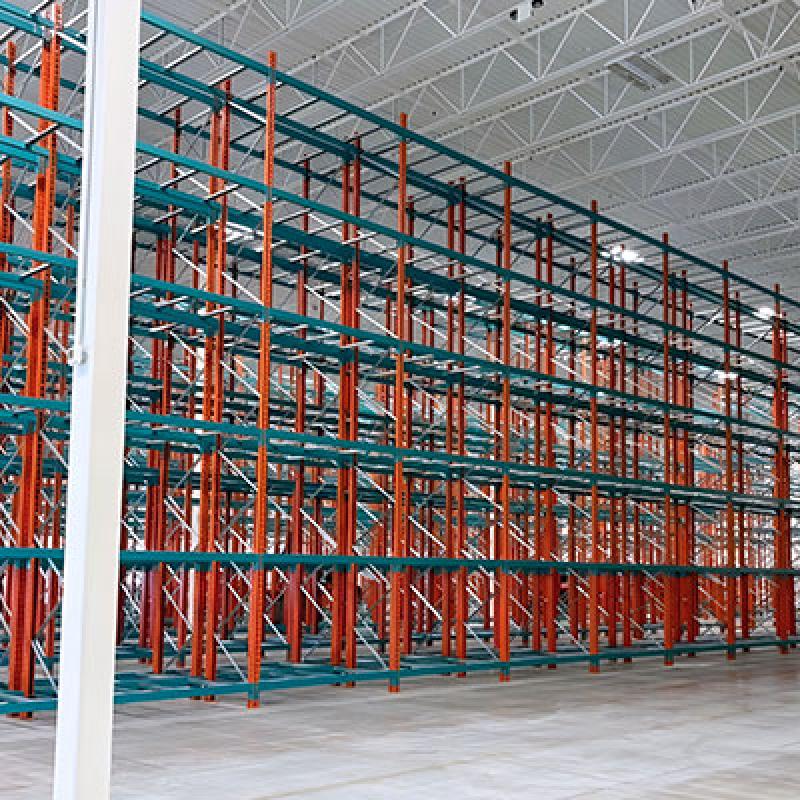
The Canadian industrial storage market is in the middle of a quiet but significant shift.
A combination of tariff measures, trade remedy actions, and supply chain pressures is changing the economics of imported racking products, and the implications are already being felt across new builds, tenant fit-ups, and existing facility upgrades.
For most industrial real estate stakeholders, the inner workings of trade policy may sound like inside baseball. They are not. The Canadian steel rack market is estimated at roughly $415 million annually, and the trade environment of the past eighteen months is reshaping how racking is sourced, specified, and valued inside Canadian industrial buildings.
The new sourcing reality
For years, Canadian occupiers could choose from three sourcing lanes: domestic-manufactured, American-manufactured, or imported overseas product (predominantly from China, but also Southeast Asia and Eastern Europe). Each lane carried different trade-offs on price, lead time, and quality, but the gap between them was manageable.
That calculus has shifted. Canada imposed a 25 per cent surtax on U.S. steel and aluminum in March 2025, followed by a 25 per cent global tariff on a broad list of steel derivative products in December 2025. Tariff rate quotas on primary steel from non-free trade partners have been reduced to 20 per cent of their 2024 levels. The remissions that had softened the blow for Canadian manufacturers largely expired in early 2026. The federal Buy Canadian Policy, introduced in late 2025, now requires Canadian steel in government-funded infrastructure contracts above specified thresholds.
On top of all of this, a 50 per cent freight discount on interprovincial steel shipments took effect in spring 2026, directly rewarding Canadian-to-Canadian supply chains.
The result: imported racking is not just more expensive. It is exposed to a layered tariff regime that can change quarterly, creating real budget and schedule risk for any project that locks in pricing months before delivery.
Where the steel comes from matters
A common misconception is that "racking is racking." In practice, the origin of the underlying coil is one of the most important factors in long-term system performance. Steel melted and poured in North America generally meets tighter chemistry and consistency standards than product coming out of oversupplied global steelmaking regions where environmental and labour standards are weaker. Canadian trade authorities have repeatedly found, across multiple steel categories, that dumped offshore steel was entering Canada at prices that did not reflect fair production costs.
For racking, this is not abstract. Post and beam steel must hold engineered load ratings to the exact specifications in the manufacturer's certification. When input coil varies in thickness tolerance, yield strength, or weld integrity, the engineered capacity of the finished rack can be compromised. The problem is that most end users never see the mill certificates, and would not know how to interpret them if they did.
Canadian manufacturers that source coil domestically are able to tie structural calculations to verifiable input specifications. That traceability is what allows engineers to sign off on load ratings with confidence, and it is what stands up to scrutiny under a CSA A344 audit or a fire marshal review.
The engineering and code problem
Canadian racking must comply with CSA A344, the National Building Code, the applicable provincial code (most notably the updated Ontario Building Code 2025), and NFPA 13 for fire suppression. Imported racking is frequently designed to ANSI/RMI standards or, in some cases, to domestic standards in the country of origin that do not align with Canadian seismic, snow, or fire loads.
Imported systems regularly arrive on Canadian sites lacking proper seismic anchorage for British Columbia or Quebec, with undersized footplates for typical Canadian slab conditions, or with beam-to-column connections that fail to meet CSA A344 ductility requirements. Retrofitting a non-compliant system after installation is slow and expensive, and in the worst cases the system has to be torn out and replaced. For a landlord facing a lease start date, that is a catastrophic schedule hit.
The supply chain problem
Overseas racking typically moves by ocean freight, with lead times of twelve to sixteen weeks before tariff inspections and port delays are factored in. U.S.-manufactured racking can move quickly under normal conditions, but cross-border trucking is now subject to surtax calculations, additional paperwork, and occasional hold-ups that domestic shipments simply do not face.
By contrast, racking manufactured in Canada ships and installs within Canadian borders. Lead times are predictable, freight costs are discounted under the 2026 interprovincial program, and domestic supply chains are not exposed to evolving trade remedy actions.
What it means for industrial real estate stakeholders
For developers, brokers, and institutional landlords, the takeaway is straightforward. Racking is no longer a neutral commodity decision. The sourcing lane chosen at the specification stage determines a building's tariff exposure, compliance risk, and delivery certainty. In a market where "speed to air" and "exit velocity" drive asset value, those three factors matter far more than a marginal per-beam cost difference.
Domestic-manufactured racking is rarely the lowest line-item quote. It is almost always the lowest total cost of ownership once tariffs, compliance, lead times, and long-term reconfigurability are factored into the model.
As one of Canada's leading manufacturers of pallet racking and industrial storage systems, North American Steel would be happy to discuss the sourcing, engineering, and compliance implications of any upcoming project in greater detail.



 Industry Events
 Locations