



 Locations







Estimates of the U.S. housing shortage vary, depending on who’s counting and what’s being measured. Over the last few years, Moody’s estimates the shortage of homes at 2 million, while Goldman Sachs says 3 to 4 million. Freddie Mac’s 2024 estimates put the number at 3.7 million, while Zillow estimates 4.7 million today. While the precise number is debated, the broader concern remains: the U.S. is not building enough homes.
Last year, Texas led the nation in corporate headquarters relocations, with annual nationwide relocations jumping from 96 in 2024 to 164 in 2025, according to CBRE. The Texas Comptroller of Public Accounts highlighted in its previous year’s housing Affordability Challenge report that population growth, particularly in major metropolitan (metro) areas, was contributing to a statewide housing shortage. A widening gap between housing demand and the supply of affordable homes is putting increasing pressure on some Texan markets.
But the opportunity is not as simple as “invest in Texas”. On the ground, the residential land acquisition and development—lot development—market is telling a more nuanced story, one that only becomes visible when you get into the submarkets.
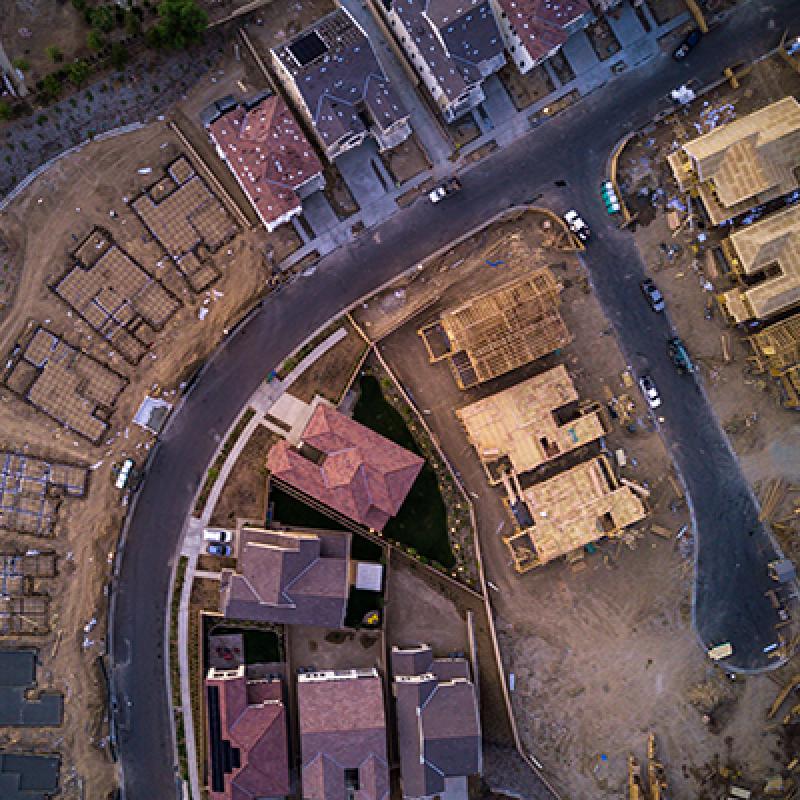
Same city, different market
Take Houston. At the metro level, the data suggests a market in transition. But within the same metro area, the picture differs depending on where you are. South Houston and select outer suburban corridors are carrying elevated for-sale housing inventory, with certain submarkets approaching nine months of supply, according to the Houston Chronicle. Parts of north Houston tell a different story. Data from the Houston Association of Realtors shows established communities closer to the Woodlands corridor maintain tight inventory and active consumer demand.
Dallas tells a similar story. Submarkets tied to some corporate relocation corridors continue to tighten while others that attracted aggressive development are working through a longer absorption cycle. The demand is real, but it is concentrated in specific corridors, not spread evenly across the metro.
Investors and lenders assessing Houston or Dallas as a single market risk overlooking opportunities in areas where supply and demand remain more aligned. This reinforces the importance of looking beyond headline market data. Metro-level statistics may point to softening conditions, but sector experience and underwriting decisions are increasingly won or lost at the submarket level. Employment growth, school districts, transportation access, and the local supply pipeline often affect demand more than broader regional trends.
What builders are actually doing
What builders are doing right now tells you a lot about the current market. U.S. 30-year fixed mortgage rates have now surpassed the 7.0% threshold, reaching their highest level since November 2023, according to Freddie Mac. That is flowing directly into buyer affordability, particularly at the entry level. Some builders are prioritizing pace over price, accepting lower margins to keep lots turning. Others are pulling back on starts to protect margins. A builder’s direction depends on their balance sheet, whether they are publicly traded, their land position, and how deep they are into their lot contracts.
The move-up and luxury segments appear to be holding up better than the starter market, as those buyers are less sensitive to mortgage rates and many are cash buyers. To address affordability issues, builders are responding with smaller floor plans and working with municipalities on reimbursement structures that reduce lot costs and help deliver a more affordable product. In Texas, that municipal support is becoming a more meaningful part of the development equation than it was even two years ago. The shift toward smaller product is not just a response to rates. It reflects a structural change in who is buying. John Burns Research and Consulting estimates the U.S. has 4.3 million fewer households than it would have if home-sharing patterns had remained at 2010 levels. The firm’s September 2026 analysis shows average household size has declined from 2.54 to 2.42 people since 2010, driven by fewer children per household and more seniors living alone. The implication for lot developers is that product demand is shifting.
What has not changed is that builders need to maintain a multi-year pipeline of lots ahead of them. Even in a compressed-margin environment, they are taking down finished lots in submarkets where demand is proven. The future pipeline has not stopped. It has gotten more selective.
The supply side will tighten
Projects across the country are taking longer to process entitlements and deliver permits. Projects that used to move through the approval process on a predictable timeframe now take significantly longer. Nationally, residential permits have dropped annually for 42 consecutive months, according to Zillow. Construction costs have not retreated materially, and the land availability in desirable submarkets is becoming harder to assemble at a basis that produces a viable return.
The next round of finished lots may cost more and take longer to deliver. For homebuilders who need inventory ahead of them, competition for well-located, properly entitled lots in proven submarkets will intensify, not ease, even if the broader market feels soft.
New capital is entering the space
Over the past 12 to 36 months, meaningful new capital has moved into residential development financing. Large New York-based platforms are expanding into the space. Land banking firms are entering the market. Lending platforms with 10 or 20 different product lines are adding residential land development financing to the menu. The key distinction is not how much capital is being committed, but the experience and patience investment firms bring to the sector. Firms that showed up because yields looked attractive in 2024 will be tested when the market requires knowledge and patience over momentum, and sector experience will prevail.
Founded in 1997, Trez Capital has provided commercial real estate financing throughout the U.S. since 2010, focusing on residential opportunities through lot development, multi-family and build-to-rent lending and equity platforms. We have completed over 300 lot development loans totalling more than $6 billion. Many on our lending team come from the building and development side and have managed projects, dealt with cities and delivered commercial projects and single-family lots—they understand the difficulties and nuances in dealing with cities and municipalities while navigating the development process. That is why roughly 70% of our U.S. business comes from repeat borrowers. And we are not just lending into these markets; through the Trez Capital U.S. Opportunity Fund series, we co-invest equity alongside our select development partners. We share conviction in the long-term outlook for U.S. residential land development financing, and when we tell a borrower we believe in a submarket, our own capital is behind that.
What comes next
Multi-family in the U.S. is working through an overbuilding cycle. The multi-family market is moving toward a bottom as the development pipeline thins, with new supply expected to reach a low point in 2027. Single-family lot development will follow a similar pattern: the overbuilt submarkets will work through excess inventory, and the disciplined submarkets will tighten further.
The housing supply gap is structural. The conditions needed to close it won’t arrive any time soon. The opportunity is specific: It lives in the submarket where lot inventory is tight, builders are committed, entitlements are in place, and population growth exceeds the forecast.
This is where the distinction between a metro-level thesis and a submarket-level investment becomes critical—and where experience matters. A growing metro does not mean every submarket is undersupplied. The opportunity lies in identifying where demand is durable, supply is constrained, and builders need lots to meet that demand. In this market, averages can hide more than they reveal.
Alec Barry is Executive Managing Director, U.S. Origination at Trez Capital. He is based in Dallas, Texas and joined the firm in 2019. He has more than 25 years of commercial real estate finance experience.


 Industry Events
 Locations

