



 Locations



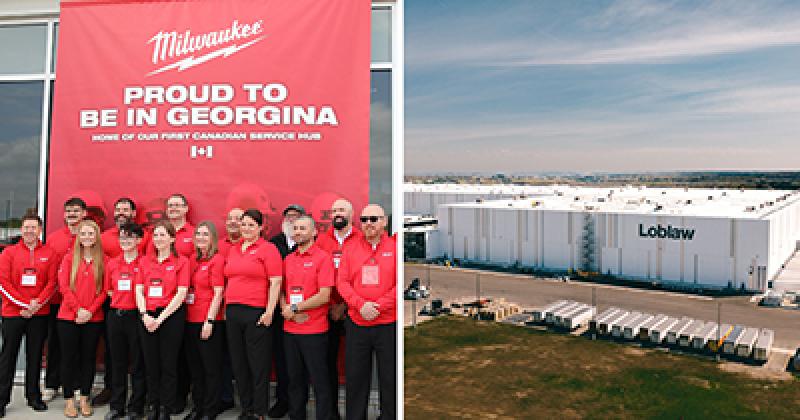
When Milwaukee Tool began the search in 2024 for a new base for its Canadian operations, executives evaluated scores of potential sites across the Greater Toronto Area (GTA) and surrounding regions. None satisfied their long list of operational criteria.
Then they decided to think beyond traditional markets, looking north for a new opportunity.
The company ultimately chose the Keswick Business Park in Georgina, ON., for its 54,000-square-foot Canadian Service Hub. The facility, which officially opened in May 2026, employs more than 80 people.
For Milwaukee Tool, the decision wasn’t based on a single factor.
“It was the overall package and the confidence that the location could support our business well into the future,” says Jenn Rooney, Talent Business Partner with Techtronic Industries Canada Inc., Milwaukee Tool’s parent company.
The combination of expedited development timelines, greenfield spaces, talent, accessibility, affordability and room to grow is increasingly important to companies and investors seeking out industrial and commercial development opportunities throughout the region. These are the same unique benefits driving commercial growth throughout Northern York Region, an area comprising East Gwillimbury, Georgina and four other municipalities.
One of the key reasons is that while established GTA employment markets offer proximity to customers and infrastructure, investors often face limited land availability, higher costs and fewer opportunities to accommodate large or specialized facilities. Put simply, there is more opportunity in the north for greenfield development.
In Northern York Region, East Gwillimbury and Georgina have significant employment lands, including more than 800 acres across the communities’ key industrial and commercial development areas that offer lease and build-to-suit opportunities. For companies requiring flexibility around building size, configuration, outdoor storage or future expansion, the advantages are real.
In Milwaukee Tool’s case, Rooney says scalability was central to the company’s decision.
“The Georgina facility gives us the space, flexibility and infrastructure we need to continue growing our business in Canada,” she says. “It was designed with expansion in mind and positions us to scale our operations as demand continues to increase.”
That room to grow is a particularly relevant consideration for corporate real estate teams and site selectors whose decisions must account for more than the immediate requirements of a facility.
Milwaukee Tool’s experience also underscores the importance of a robust labour market. Rooney says access to talent was “one of the most important factors” in the company’s decision to locate in Georgina.
Indeed, Northern York Region provides access to the broader, 3.9-million-person GTA labour market. The region has one of Canada’s highest post-secondary education rates among major jurisdictions, with 19 colleges and universities within commuting distance. More than 70 per cent of residents have either a university or college degree, or a trade specialization.
Projected population growth—from a combined total of more than 75,000 residents in 2026 to more than 200,000 by 2051—is bringing more potential employees to an area with appealing lifestyle advantages: ample, affordable housing, close-knit communities, lakeside living and the amenities of Canada’s largest city right on its doorstep.
Accessibility is another major draw to Northern York Region.
Highway 404 provides a direct connection south into the GTA, while Highway 400 connects the region with markets to the west and north. The future Bradford Bypass will provide another east-west link between the 400 and 404 corridors.
GO rail and bus service provide additional regional transportation options, while Toronto Pearson International Airport is within a 45-minute drive.
For logistics, distribution and manufacturing operations, those connections can be as important as the physical characteristics of a site. East Gwillimbury is already demonstrating that potential. Its 404 Employment Area is home to Loblaw’s 1.2-million-square-foot distribution facility, one of the largest in the grocery giant’s property portfolio. Future developments in the area will add more than 2.3 million square feet of industrial and commercial capacity.
At the same time, East Gwillimbury and Georgina have built economic development programs designed to provide investors with direct assistance through the site-selection and development process. Speed-to-market is a top priority.
In Georgina, the Business Concierge Program provides support from an introductory meeting through development applications and includes expedited approvals for eligible office, industrial and institutional projects, as well as a development application fee rebate program and development charge deferrals. East Gwillimbury’s Advantage EG similarly provides personalized support for site selection, approvals and business growth. Depending on development requirements, the goal is to take projects from inception to ribbon cutting in 18 months or less.
For Karyn Stone, Manager of Economic Development and Tourism with the Town of Georgina, that hands-on approach is an important part of the region’s appeal.
“Georgina offers investors personalized attention delivered by a team of experienced municipal professionals prepared to work directly with businesses through the development process,” says Stone. “Our goal is to make it easier for companies to understand the opportunity, navigate the process and move their projects forward.”
East Gwillimbury is also home to significant new healthcare infrastructure. Southlake Health has announced plans for a second acute-care hospital in Queensville, with planning now underway. That facility will complement a proposed life sciences park and advanced care campus in Georgina, setting the stage for a wider life sciences and healthcare ecosystem throughout the area.
Brennan Kenny, Director of Economic Development for East Gwillimbury, points to the business opportunity being about more than the availability of individual development sites.
“East Gwillimbury is experiencing the kind of growth that creates a compelling environment for long-term investment,” Kenny explains. “We have the land and transportation connections to support major projects, but we’re also building the workforce, infrastructure and complete communities that will support businesses after they open their doors.”
Milwaukee Tool’s experience suggests that Northern York Region is offering something entirely unique in the GTA: the growth-friendly conditions and municipal support that mid- to large-scale companies need to achieve business success.
“Our experience has been very positive,” says Rooney. “For organizations looking for a place where they can scale over the long term while still maintaining close access to the GTA, Northern York Region is certainly worth considering.”


 Industry Events
 Locations

